

Bonded and non-bonded bullets can look nearly identical, but the difference is inside the projectile.
A bonded bullet permanently joins its jacket to its core, helping the bullet remain intact after impact. A traditional non-bonded bullet does not permanently attach these components, which can allow the jacket and core to separate under certain impact conditions.
Does bonded mean better? Not necessarily.
Neither construction is automatically better.
When it comes to defensive handgun bullets there’s a misconception that bonded bullets are more lethal than non-bonded bullets. Some believe that the bonding of the bullet’s jacket to its core will make the bullet stop bad guys faster.
Bonded defensive handgun bullets do have some advantages over their non-bonded counterparts, but you might be surprised to learn just exactly what those advantages are.
Bonded bullets generally emphasize weight retention and structural integrity, while non-bonded bullets can provide excellent expansion and penetration depending on their design. The better option depends on the cartridge, bullet design, firearm, and intended application.
How Bullets Work
Before we get into the differences in bonded and non-bonded bullets, let’s look at how bullets work to stop bad guys.
From the moment a bullet impacts a threat it starts to deform.
The amount of deformation that occurs is determined by the bullets impact velocity, its construction, and what it impacts.
Optimally, the bullet’s jacket will peel back exposing the lead or lead alloy core, and this flowering or opening of the bullet will cease when its overall frontal diameter has increased by about 1.5 times its original diameter.
Bullets that open with a smaller diameter can over penetrate and bullets that open with a larger diameter can fail to penetrate enough.

What you may find surprising is that this deformation, which is also called expansion, begins and ends, within about three inches of penetration.
After penetrating that deep the bullet has slowed to the point that there is not enough remaining velocity/energy to cause additional shape change.
At this point the bullet is just poking a hole that is equal to its deformed frontal diameter.
FBI Handgun Bullet Protocol
Up until the latter part of the last century most defensive handgun bullets were not bonded.
However, after the notorious FBI shootout in Miami, the FBI began to look more closely at how defensive handgun bullets performed.
Not only did they want a bullet that would deform to 1.5 times its original diameter, but they also wanted it to penetrate between 12 and 18 inches in 10 percent ordnance gelatin, which was the test media they felt best replicated soft human tissues.
A lot of defensive handgun bullets could meet this requirement, but the FBI complicated the standard by asking that the bullet deliver this level of performance after passing through a variety of intermediate barriers like heavy clothing, wall board, plywood, sheet steel, and auto glass.
Handgun Bullets vs Barriers
Based on their data, the FBI felt their agents were likely to have to shoot through barriers such as these to hit the bad guys they might be shooting at.
Extensive testing had shown that many conventical defensive handgun bullets could not deliver the desired terminal performance after encountering these barriers.
In some cases, the barriers pulled the jacket away from the core and this limited the bullet’s wounding potential.
One of the ways bullet manufactures responded was to bond the bullet’s jacket and core together.
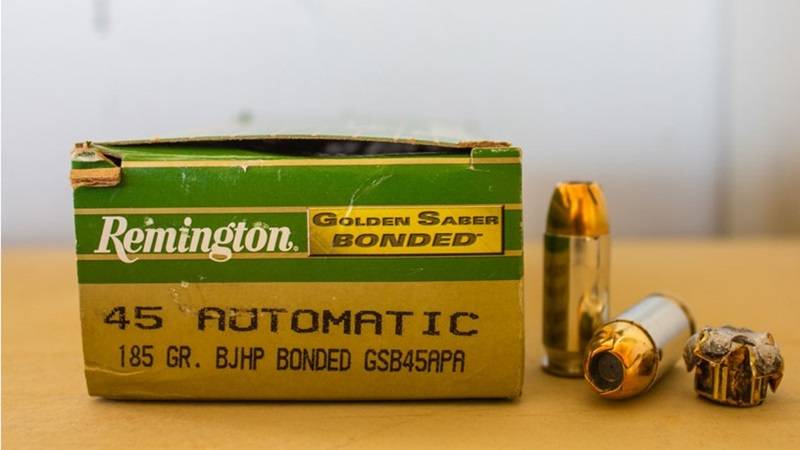
These alterations proved effective at delivering the barrier defeating terminal performance the FBI was looking for.
It is a fact that law enforcement officers are more likely than civilians to have to shoot through a barrier to hit a bad guy.
In most instances where a civilian uses a defensive handgun, it is a shooting, not a shootout.
And, when the only barrier between the gun and the bad guy is clothing, the bonded bullets do not offer a substantial increase in terminal performance.
In fact, when clothing is the only intermediate barrier, some non-bonded bullets perform just as well or even better than their bonded counterpart.
Bonded vs Non-Bonded Comparison Chart
| Caliber | Common Bonded Bullet Weights | Common Non-Bonded Bullet Weights |
|---|---|---|
| 9mm | 124 gr, 147 gr | 115 gr, 124 gr, 135 gr, 147 gr |
| .380 ACP | 90 gr, 99 gr | 90 gr, 95 gr, 99 gr, 100 gr |
| .38 Special | 125 gr, 130 gr, 135 gr | 110 gr, 125 gr, 130 gr, 148 gr, 158 gr |
| .357 Magnum | 125 gr, 140 gr, 158 gr | 110 gr, 125 gr, 140 gr, 158 gr, 180 gr |
| .357 SIG | 125 gr | 115 gr, 125 gr, 147 gr |
| .40 S&W | 165 gr, 180 gr | 155 gr, 165 gr, 180 gr |
| .45 ACP | 185 gr, 200 gr, 230 gr | 185 gr, 200 gr, 230 gr |
| 10mm Auto | 180 gr, 200 gr | 155 gr, 165 gr, 180 gr, 200 gr, 220 gr |
Common Bonded Calibers
Bonded bullets are available across many popular handgun calibers, particularly in ammunition designed for personal protection and duty applications. While the basic bonding concept remains similar, bullet weight, velocity, expansion, and penetration characteristics can vary considerably from one caliber and load to another.
9mm Bonded Ammo
9mm ammunition is one of the most common calibers available with bonded hollow-point bullets.
Bonded 9mm projectiles are designed to help keep the jacket and core together as the bullet expands, improving weight retention and reducing the likelihood of jacket-core separation. Shooters can find bonded 9mm ammunition in several bullet weights as well as standard-pressure and +P configurations.
38 Special Bonded Ammo
38 Special ammunition is available with bonded bullets designed for revolvers, including loads developed specifically for shorter barrels.
Because compact revolvers can produce lower velocities than longer-barreled firearms, manufacturers may tailor bullet construction and expansion characteristics accordingly. Bonded 38 Special loads are also available in +P configurations for firearms rated to use +P ammunition.
357 Magnum Bonded Ammo
357 Magnum ammunition combines the cartridge's higher velocity potential with bonded bullet construction. Keeping the jacket and core together can be especially useful when a bullet experiences significant deformation during expansion.
Bonded 357 Magnum loads are available in different bullet weights and configurations for defensive and other applications.
40 S&W Bonded Ammo
40 S&W ammunition is available with several bonded hollow-point designs.
These projectiles combine the caliber's common defensive bullet weights with construction intended to promote controlled expansion and weight retention. Bonded 40 S&W ammunition has also been widely associated with duty-oriented handgun loads.
45 ACP Bonded Ammo
45 ACP ammunition is available with bonded hollow-point bullets in multiple weights and configurations.
Because 45 ACP typically uses relatively heavy, large-diameter projectiles, bonded construction can help maintain bullet integrity as the hollow point expands. Both standard-pressure and +P bonded loads are available, depending on the manufacturer and specific ammunition line.
10mm Auto Bonded Ammo
10mm ammunition can also be loaded with bonded projectiles.
The cartridge's velocity and energy make bullet construction an important consideration, particularly when significant expansion or penetration is expected. Bonded 10mm bullets are designed to resist jacket-core separation and retain more of their original structure as they travel through the target.
380 ACP Bonded Ammo
380 ACP ammunition is another caliber in which bonded bullet designs are available.
Because 380 ACP generally operates at lower velocities than larger defensive handgun cartridges, manufacturers must balance expansion with sufficient penetration. A bonded design can help the projectile remain intact during expansion, although performance ultimately depends on the individual bullet and load.
Price of Bonded vs Non-Bonded
Another difference between bonded and non-bonded defensive handgun ammunition is price.
As an example, Remington’s bonded version of their Golden Saber – brass jacketed hollow point bullet – will cost between 25 and 75 cents more per round more than their non-bonded brass jacketed hollow point loads.
This works out to about a 50 percent increase in price but, it’s really not a lot of money.
If you rotate your carry ammo once a year, you’ll only need about two boxes per year, which works out to a yearly price increase of only about $20.
Monometal Defensive Handgun Bullet Options
Another very good defensive handgun bullet that gets overlooked in the bonded/non-bonded bullet argument is the mono-metal bullet.
A mono-metal bullet like the Barnes TAC-XP does not have a jacket or a core, it is simply a solid piece of copper with a large hollow point that causes the bullet to deform similar to jacketed hollow point bullets.
The Barnes TAC-XP bullet delivers very good terminal performance in normal situations and through barriers.
For the civilian who is carrying a concealed handgun for personal protection, bonded, non-bonded, and mono-metal bullets are all good choices.
What is just as, if not more important, is that the ammo you choose for your defensive handgun will function with 100 percent reliability.
The best bullet in the world will not help you at all if you cannot get it to the threat.
Which One Should You Choose?
Bonded bullets may be worth considering when:
- Maintaining projectile integrity is an important design consideration.
- Consistent weight retention is desired.
- The ammunition is designed to perform after encountering intermediate materials.
- The particular load performs reliably in the shooter's firearm.
Non-bonded bullets may be worth considering when:
- Barrier performance isn't the primary consideration.
- A proven non-bonded projectile provides the desired expansion and penetration.
- Lower ammunition cost is important.
- The particular load functions reliably in the firearm.
Bonded Bullet FAQs
Question: What is a bonded bullet?
Answer: A bonded bullet permanently joins its jacket to its core. This construction helps the projectile remain intact during expansion and can improve weight retention after impact.
Question: What is a non-bonded bullet?
Answer: A non-bonded bullet uses a jacket and core that are not permanently bonded together. Performance varies widely because non-bonded bullets include many different projectile designs.
Question: Are bonded bullets better than non-bonded bullets?
Answer: Not automatically. Bonded bullets generally offer greater resistance to jacket-core separation, but well-designed non-bonded bullets can also provide reliable expansion and penetration. Intended use and individual bullet design matter more than the bonded label alone.
Question: What is a bonded hollow point?
Answer: A bonded hollow point combines an expanding hollow-point design with a jacket that is bonded to the bullet's core. The construction is intended to promote expansion while helping the projectile retain its structural integrity.
Question: Do bonded bullets expand?
Answer: Yes. Many bonded defensive bullets are specifically engineered to expand while keeping their jacket and core together.
Question: Do bonded bullets penetrate farther?
Answer: Not necessarily. Penetration depends on bullet weight, velocity, expansion, construction and what the projectile encounters. Bonding is only one variable.
Question: What is bullet weight retention?
Answer: Weight retention describes how much of a projectile's original mass remains after impact. Bonded construction can help reduce the amount of jacket and core material that separates from the projectile.
Question: Are all hollow-point bullets bonded?
Answer: No. Hollow-point bullets can use bonded, non-bonded or monolithic construction.
Question: What's the difference between bonded and monolithic bullets?
Answer: A traditional bonded bullet generally joins a separate jacket and core. A monolithic projectile is made primarily from a single material, such as copper, so there is no separate jacket and lead core to bond together.


